

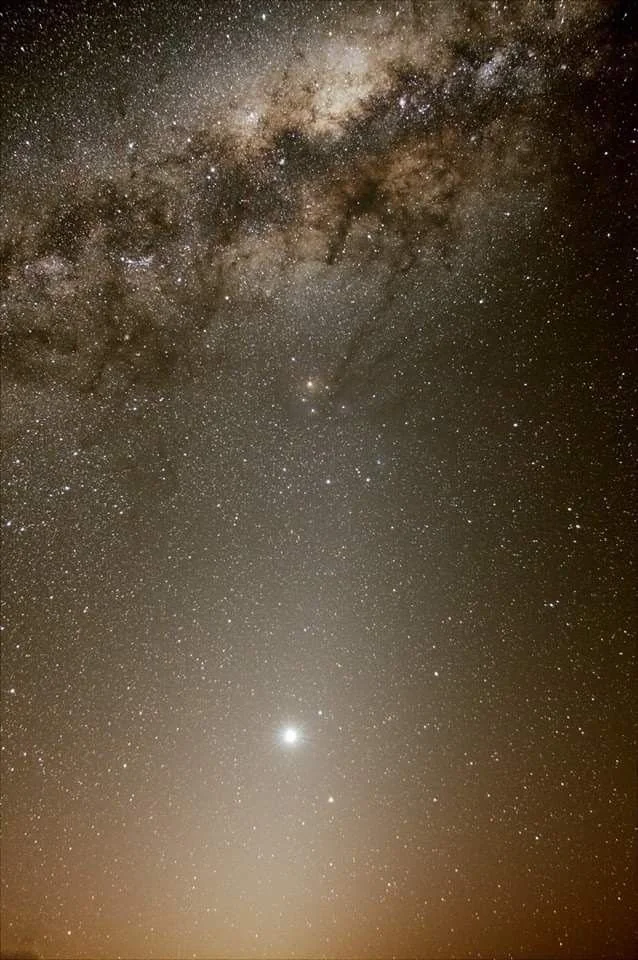
❤️☀️Love and Light☀️❤️
There is a deep way in which the concepts of Light and Love can be understood as describing similar patterns of relationship, connection, and life.
The first thing to notice is that both words are often used to describe something that unites rather than divides.
Light is what allows things to become visible. It reveals relationships between objects. Without light, forms disappear into obscurity. Light makes connection possible because it allows awareness, perception, and interaction.
Love, in its broadest sense, is also a force of connection. Love draws individuals, families, communities, and even species into cooperative relationships. Love reduces separation and increases participation in a larger whole.
In this sense, both light and love can be viewed as metaphors for relationship.
A philosopher might say: Light connects things through visibility. Love connects things through meaning.
Light allows a flower and a bee to find each other. Love allows a parent and child to care for each other. Both are forms of connection.
From a biological perspective, the connection becomes even more interesting.
The Sun powers photosynthesis. Photosynthesis produces food. Food supports life. Life gives rise to nervous systems, consciousness, emotion, attachment, empathy, and what humans call love.
Without sunlight, there would be no plants. Without plants, there would be no complex animal life. Without complex life, there would be no human affection, compassion, friendship, or love. Thus, one could poetically argue:
Light becomes life, and life becomes love.
The chain looks something like this:
Light → Energy → Life → Consciousness → Relationship → Love
Under this view, love is not separate from light but one of its highest biological and psychological expressions. There is also a symbolic dimension found across many civilizations. The Sun has frequently been associated with life, generosity, warmth, fertility, growth, healing, truth, and order. These are many of the same qualities that people associate with love.
Light nourishes. Love nourishes.
Light reveals. Love understands.
Light warms. Love comforts.
Light enables growth. Love enables growth.
Because the patterns are similar, cultures repeatedly linked them together. The opposite pairings also share similarities:
Light = Visibility, Awareness, Growth and Connection.
Darkness = Obscurity, Ignorance, Stagnation and Separation.
Love = Connection, Care. Cooperation and Unity.
Hate = Division, Harm, Conflict and Alienation.
This is why many spiritual traditions use light as a symbol for love and love as a symbol for light. However, there is an important distinction.
In physics, darkness is simply the absence of visible light. But hate is not merely the absence of love. Hate is an active emotional state, whereas indifference would be closer to the absence of love. So the analogy is powerful, but not exact. A deeper philosophical formulation might be:
Light is the physical principle that enables life to emerge and connect with its environment. Love is the conscious principle through which living beings recognize and preserve those connections.
Under this view, light and love are not identical things, but they describe the same underlying pattern at different levels of reality.
At the physical level, light creates and sustains the conditions for life.
At the biological level, life develops interdependence.
At the psychological level, interdependence becomes affection, empathy, and care.
At the ethical level, care becomes love.
So one could summarize the relationship this way:
Light is the foundation of connection in the physical world.
Love is the experience of connection in the conscious world.
Or more poetically:
Light is how the universe touches life. Love is how life touches itself.
In that sense, many philosophical and spiritual traditions have regarded love as the inner expression of the same connective principle that light expresses outwardly. Whether one interprets that literally, symbolically, metaphysically, or poetically, both words point toward a common theme: the movement from separation toward relationship, from isolation toward participation, and from fragmentation toward wholeness.
Literally
Light physically connects the Earth into a living system.
The Sun drives weather, climate, photosynthesis, ecosystems, food webs, and biological rhythms. Oceans, forests, clouds, winds, animals, and humans all participate in one interconnected planetary process powered primarily by solar energy.
Love, in the literal human sense, connects individuals into families, communities, and civilizations. Both describe networks of relationship.
Scientifically
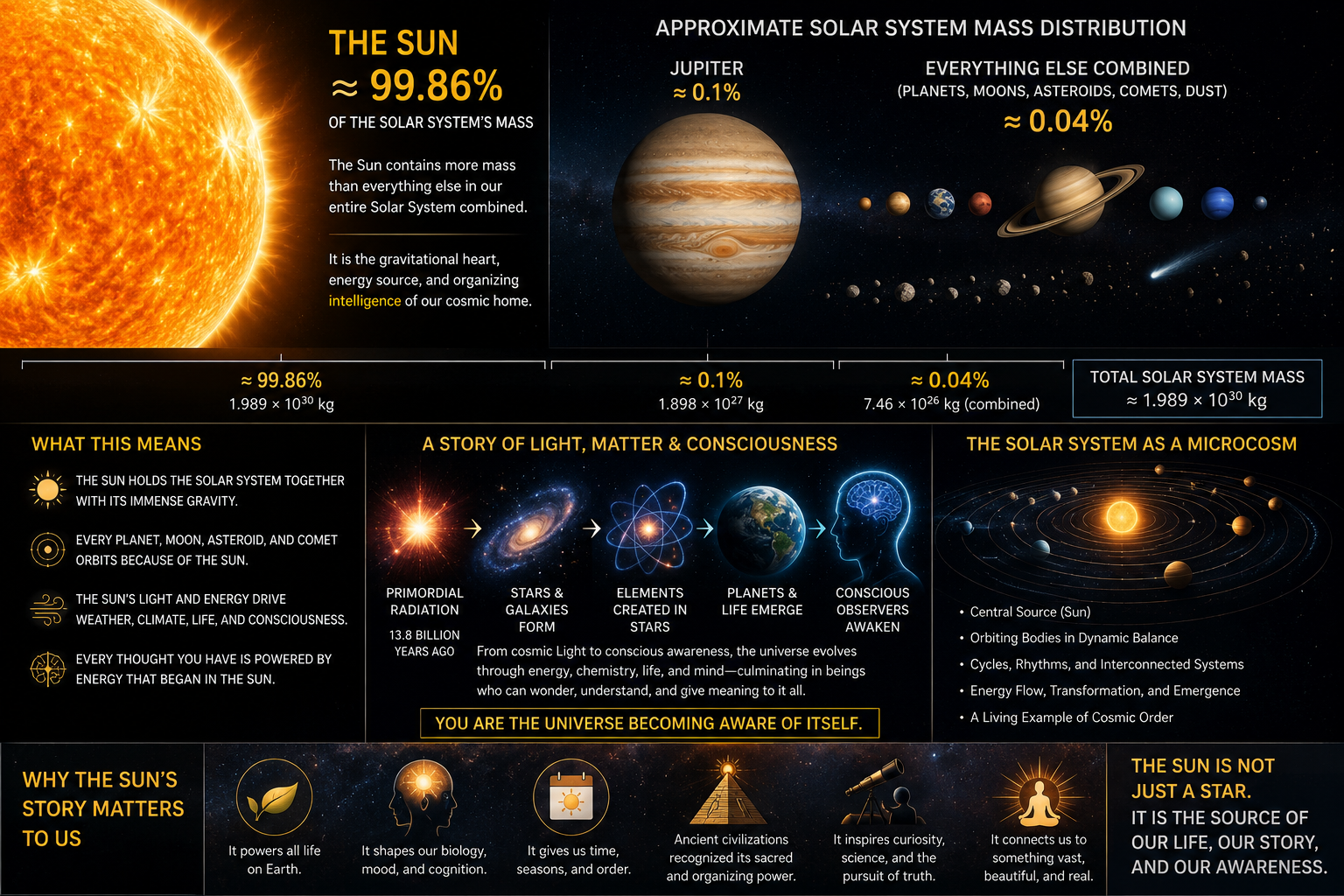
Light is not merely something we see. It is the primary energy source for almost all life on Earth.
The Sun drives evaporation, cloud formation, rainfall, winds, ocean currents, plant growth, and the energy chains that sustain life.
Even weather itself is a grand expression of solar interconnection.
A cloud is connected to an ocean. A river is connected to a mountain.
A forest is connected to sunlight. A human is connected to all three.
Likewise, love can be understood scientifically as the biological and psychological mechanisms that create social cohesion, cooperation, attachment, empathy, and survival.
Light creates interconnected ecosystems. Love creates interconnected societies.
Logically
Anything that increases relationship tends toward greater coherence. Anything that increases separation tends toward greater fragmentation.
Light increases information. Love increases understanding.
Darkness obscures. Hatred divides.
Both light and love can be understood as forces that reduce isolation and increase participation in larger systems.
Symbolically
Across cultures, light symbolizes truth, wisdom, life, awareness, and harmony.
Love symbolizes compassion, unity, care, and belonging. The symbolism overlaps because both point toward connection.
A candle illuminating a room becomes a symbol of understanding. An act of kindness illuminating a life becomes a symbol of love.
Both "light up" what was previously disconnected.
Metaphysically
Many philosophical traditions have viewed reality as an interconnected whole.
Under this perspective, light represents the principle by which existence becomes manifest and visible.
Love represents the principle by which existence recognizes its unity with itself.
In this interpretation: Light reveals the interconnectedness of reality. Love experiences the interconnectedness of reality.
Poetically
The weather offers a beautiful example.
Sunlight warms the oceans. The oceans rise into clouds. The clouds become rain. The rain feeds rivers.
The rivers nourish forests. The forests release oxygen. The oxygen sustains animals and people.
Everything participates in everything else. Nothing exists alone.
Love can be viewed similarly. One act of care inspires another. One generation nurtures the next.
One friendship influences a community. One kindness ripples outward.
Like sunlight becoming weather, love becomes relationship. Like rain returning to the sea, relationship returns to wholeness.
Ethically
When people speak of love as an ethical principle, they usually mean actions that increase well-being, cooperation, understanding, and flourishing.
These actions tend to create greater coherence within human systems.
Hatred, cruelty, exploitation, and deception tend to produce fragmentation and disorder.
Ethically speaking: Love is the practice of increasing connection.
Just as sunlight continuously nourishes and integrates Earth's living systems, love continuously nourishes and integrates human systems.
In that sense, whether one speaks literally, scientifically, logically, symbolically, metaphysically, poetically, or ethically, light and love repeatedly converge upon the same pattern: Coherence.
The emergence of relationship. The participation of parts within a greater whole. The movement from isolation toward connection.
The movement from fragmentation toward wholeness. The realization that nothing truly exists by itself, but through its relationships with everything around it.
Light is the physical language of that interconnection.
Love is the conscious experience of that interconnection.
🪶42 DECLARATIONS OF ALIGNMENT WITH MA’AT 🪶
Maat, the Sun, and the Stars may be understood as different expressions of the same underlying principle: the reality of order, harmony, balance, interconnection, and sustained existence. The stars move according to natural laws, the Sun gives light and energy that make life possible on Earth, and Maat represents the ethical and cosmic principle of truth, balance, reciprocity, and right relationship. Together they reveal a universe not founded upon chaos, but upon patterns, cycles, and relationships that sustain life and understanding. Humanity is therefore challenged to live in alignment with this Solar Order—to seek truth over ignorance, harmony over conflict, stewardship over exploitation, and wisdom over division. To live according to Maat is to recognize our place within the greater community of life, the Earth, the Solar System, and the cosmos itself. The future of humanity depends not on separation from nature, but on deeper participation in the principles that have guided the stars, illuminated the Earth, and sustained life since the beginning: truth, balance, responsibility, compassion, and the enduring Light from which all living beings ultimately arise.
The Papyrus of Ani is one of the most famous surviving Kemetic/Egyptian texts and is associated with what is more accurately known as the Book of Coming Forth by Day. Modern interpretations often reduce it to a collection of spells for the dead, yet the text is better understood as a guide to conscious alignment with Maat—the principles of truth, balance, harmony, and cosmic order. Its teachings emphasize ethical conduct, self-knowledge, integrity, and living in accordance with the patterns that sustain both human society and the greater cosmos. The famous weighing of the heart is not merely a scene of supernatural judgment, but a profound symbol of accountability, where one's thoughts, actions, and character are measured against truth itself. In relation to Light, the Papyrus of Ani may be understood as a journey from ignorance toward awareness, from disorder toward harmony, and from confusion toward understanding. Its enduring fascination lies in its exploration of timeless human questions: How should we live? What does it mean to embody truth? And how can we align ourselves with the greater order revealed in nature, consciousness, the Sun, the stars, and the rhythms of the cosmos?
The so-called “Negative Confessions” are often translated through a framework shaped by later moral theology: sin, judgment, guilt, obedience, purity, and “confession” in the Abrahamic sense. But the older Egyptian context — especially in the Old and Middle Kingdom streams that eventually culminate in later literature — is far more relational, ecological, harmonic, and cosmological.
The ancient concept of Ma’at is not merely “truth” or “justice” in the modern legal sense. It is the dynamic equilibrium that allows existence itself to remain coherent:
the balance of flood and drought,
reciprocity between humans and nature,
integrity between speech and reality,
proportion in action,
measured conduct,
social harmony,
ecological continuity,
and alignment between consciousness and the living order of existence.
Likewise, isfet is not simply “evil.” It is disorder, rupture, excess, predation, deception, imbalance, fragmentation, chaos without reciprocity — the breakdown of sustainable harmony.
The declarations traditionally called the “42 Negative Confessions” were therefore less about groveling before a deity and more about affirming one’s participation in the continuity of life and order. They are declarations of relational integrity.
A reinterpretive rendering — stripped as much as possible of later theological overlays — may sound closer to this:
THE 42 DECLARATIONS OF ALIGNMENT WITH MA’AT
A reinterpretive rendering
I did not create unnecessary suffering among people.
I did not use power without balance or measure.
I did not take what sustained another’s life.
I did not exploit hunger, desperation, or weakness.
I did not obstruct the flow of truth.
I did not manipulate perception for selfish gain.
I did not sever relationships through reckless speech.
I did not spread division where harmony was possible.
I did not poison the waters — literal or symbolic — upon which life depends.
I did not destroy fertile land, living systems, or sources of renewal.
I did not diminish the dignity of another being.
I did not use knowledge to dominate unjustly.
I did not hoard what should circulate for collective well-being.
I did not increase fear in order to control others.
I did not weaponize anger beyond necessity or proportion.
I did not abandon responsibility when action was required.
I did not distort memory, record, or witness.
I did not silence voices through coercion or intimidation.
I did not disrupt rightful reciprocity between people.
I did not consume beyond balance while others lacked sustenance.
I did not treat living beings as though they were without value.
I did not speak falsely to gain status, wealth, or influence.
I did not exploit sacred trust.
I did not turn away from suffering when compassion was possible.
I did not mistake possession for worth.
I did not confuse force with wisdom.
I did not place myself above the order that sustains existence.
I did not act as though my desires outweighed the needs of the whole.
I did not disrupt the harmony of family, community, or kinship.
I did not create imbalance through greed or excess.
I did not misuse sexuality, affection, or intimacy to manipulate others.
I did not take pleasure in cruelty or humiliation.
I did not deny reality when truth was visible.
I did not close myself to learning, reflection, or correction.
I did not turn knowledge into arrogance.
I did not destroy beauty, craft, or meaningful creation.
I did not reduce life to profit alone.
I did not sever humanity from nature.
I did not speak in ways that fractured collective harmony.
I did not cultivate inner chaos and project it outward.
I acted with measure because existence itself depends upon balance.
I sought to live in reciprocity with the living order of the cosmos.
REINTERPRETING THE “WORDS OF MA’AT”
One of the greatest distortions introduced by colonial-era Egyptology was the assumption that Egyptian spiritual language functioned like later Western religion.
Many translations unconsciously inserted:
Christian moral categories,
Greco-Roman metaphysics,
medieval legalism,
Victorian moralism,
and Protestant notions of guilt and confession.
This transformed living cosmological concepts into rigid “commandments.”
But Egyptian thought was often process-oriented rather than absolutist.
1. MA’AT WAS NOT MERELY “MORALITY”
The usual translations:
truth,
justice,
righteousness,
are incomplete.
Ma’at includes:
balance,
proportionality,
coherence,
ecological sustainability,
truthful speech,
lawful continuity,
harmonic reciprocity,
social equilibrium,
cosmic stability.
It is closer to:
“the conditions under which life can continue harmoniously.”
The Nile flood itself was Ma’at.
Seasonal regularity was Ma’at.
Accurate speech was Ma’at.
Fair exchange was Ma’at.
Music in tune was Ma’at.
Astronomical regularity was Ma’at.
A ruler maintaining food stability was Ma’at.
A person acting with restraint and integrity was Ma’at.
2. “SIN” IS A POOR TRANSLATION
Ancient Egyptian texts rarely frame wrongdoing as permanent metaphysical corruption.
Most actions are understood through:
imbalance,
excess,
disruption,
disorder,
failed reciprocity,
misalignment.
The issue is not “offending God” in the later theological sense.
The issue is:
Does this action contribute to the continuation of harmonious existence?
That is profoundly different.
3. THE HEART WAS NOT A “SOUL” IN THE LATER WESTERN SENSE
The weighing of the heart is often rendered through later dualistic theology.
But the ib (heart) was:
memory,
conscience,
intention,
cognition,
emotional center,
moral orientation,
inner patterning.
The feather of Ma’at symbolizes balance, precision, alignment, proportion, and truthful resonance.
The scene is less:
“divine courtroom sentencing”
and more:
“whether one’s inner pattern remained coherent with the sustaining order of existence.”
4. THE “GODS” WERE OFTEN FUNCTIONS OF REALITY
Many Egyptian netjeru are better understood not as comic-book supernatural personalities but as:
principles,
intelligible forces,
archetypal powers,
natural processes,
cosmic functions,
dimensions of consciousness and reality.
For example:
Ra can be read as solar generativity, illumination, cyclical renewal, consciousness, and life-giving order.
Thoth represents measurement, language, mathematics, memory, and harmonizing intelligence.
Sekhmet embodies both destructive imbalance and restorative correction.
Hathor expresses beauty, music, affection, fertility, and relational harmony.
These are not merely “mythological characters.”
They are symbolic-intellectual models of reality.
5. SPEECH ITSELF WAS CREATIVE POWER
Egyptian civilization deeply understood that language shapes social and psychological reality.
Thus truthful speech mattered enormously.
To “speak Ma’at” meant:
speech aligned with reality,
speech that sustains harmony,
speech that does not distort the collective field.
Falsehood was dangerous because it introduced instability into the human system.
This is remarkably modern.
Misinformation, propaganda, manipulative rhetoric, ecological denial, and exploitative narratives are all forms of isfet in this interpretive framework.
6. MA’AT WAS ECOLOGICAL
Modern translations often reduce Ma’at to abstract ethics.
But Egyptian life was inseparable from ecological awareness.
The civilization depended on:
flood cycles,
agriculture,
astronomical observation,
climate rhythms,
water management,
long-term continuity.
To violate balance with nature was literally existential.
Thus many ancient ethical principles imply:
moderation,
stewardship,
reciprocity,
sustainability,
interdependence.
In modern language:
Ma’at contains an ecological ethic.
7. THE GOAL WAS NOT “PERFECTION”
Another distortion is the idea that Egyptians sought impossible purity.
The evidence suggests something more nuanced:
alignment,
self-correction,
measure,
continual balancing,
restoration of harmony.
Ma’at is dynamic equilibrium, not rigid perfectionism.
Much like nature itself:
rivers shift,
seasons fluctuate,
stars move,
ecosystems adapt.
Balance is maintained through continual adjustment.
8. THE DEEPER PHILOSOPHY
At its deepest level, Ma’at expresses a universal insight:
Existence persists through relationship, reciprocity, proportion, and truthful alignment with reality.
When societies:
abandon truth,
exploit ecosystems,
glorify greed,
normalize deception,
sever reciprocity,
reward imbalance,
they move toward isfet:
fragmentation, instability, collapse.
The “Words of Ma’at” therefore become less a religious confession and more a philosophy of sustainable existence.
Not:
“I obeyed divine commands.”
But:
“I participated responsibly in the living balance that allows life to continue.”
And that may be one of the oldest ethical visions humanity ever preserved.
☀️📖✨Solar IQ Test 100 Questions of Light ✨📖☀️
An Initiatory Journey Through Reality, Knowledge, Life, Consciousness, and the Solar Story
Instructions:
At each stage, the reader is asked a question. If the answer is Yes, proceed. If the answer is No, investigate further before continuing.
The sequence begins at the largest observable scales of reality and gradually moves inward toward life, consciousness, ethics, civilization, and humanity’s future.
TABLE OF CONTENTS:
PART I — THE COSMIC OCEAN OF LIGHT
Questions 1–10
Can light travel across the observable universe?
Do we see distant galaxies through photons?
Is most of what we know about the cosmos learned through light?
Can telescopes extend human vision through light?
Does every star reveal itself through emitted photons?
Can light travel for billions of years before reaching Earth?
Is the night sky a record of the past?
Does light connect us to events long before humanity existed?
Can invisible wavelengths reveal hidden aspects of reality?
Is light humanity’s primary messenger from the universe?
PART II — PHOTONS AND THE NATURE OF REALITY
Questions 11–20
Is the photon the fundamental quantum of light?
Does light exhibit wave-particle duality?
Can photons carry information?
Can light transfer energy?
Is light essential to modern physics?
Do photons interact with matter?
Can light alter the state of physical systems?
Does quantum theory depend upon observations involving light?
Can a single photon travel vast cosmic distances?
Is light among the most fundamental phenomena known to science?
PART III — THE STORY WRITTEN IN STARS
Questions 21–30
Are stars natural engines of light production?
Is the Sun a star?
Were the elements in your body forged in ancient stars?
Does stellar light drive planetary systems?
Can stars be understood through their light spectra?
Is astronomy largely the study of light?
Do stars influence the possibility of life?
Does Earth orbit within a stellar environment?
Is our existence tied to a star’s energy output?
Can humanity trace its origins to stellar processes?
PART IV — THE SOLAR FOUNDATION OF LIFE
Questions 31–40
Does nearly all life on Earth depend upon solar energy?
Is photosynthesis powered by sunlight?
Do plants transform light into biological energy?
Does oxygen production depend largely on photosynthetic life?
Would complex life be impossible without photosynthesis?
Are food chains ultimately linked to solar energy?
Does every meal contain stored sunlight?
Are forests powered by light?
Are ecosystems expressions of energy flow?
Is the Sun the primary energy source for Earth’s biosphere?
PART V — THE EVOLUTION OF SEEING
Questions 41–50
Did vision evolve in response to light?
Do eyes detect photons?
Have eyes evolved independently multiple times?
Do animals navigate using light?
Can insects perceive wavelengths humans cannot?
Do birds use solar cues for migration?
Do marine animals depend upon light gradients?
Does light shape behavior throughout nature?
Is perception influenced by environmental illumination?
Did light help shape biological evolution?
PART VI — LIGHT, BRAIN, AND CONSCIOUSNESS
Questions 51–60
Does light influence circadian rhythms?
Does sunlight affect hormone regulation?
Does light influence sleep?
Can sunlight affect mood?
Does the brain process visual information using light-derived signals?
Does consciousness depend upon sensory information?
Is vision one of humanity’s dominant senses?
Can light alter cognition and behavior?
Does awareness expand through perception?
Is light deeply intertwined with conscious experience?
PART VII — KNOWLEDGE, OBSERVATION, AND TRUTH
Questions 61–70
Does observation play a central role in science?
Does observation require information?
Does light provide most information about the external world?
Did astronomy help launch modern science?
Are microscopes instruments of light?
Are cameras instruments of light?
Can evidence overturn previous beliefs?
Does clearer observation improve understanding?
Does knowledge often grow through greater illumination?
Is light both a physical reality and a powerful metaphor for understanding?
PART VIII — HUMAN CIVILIZATION AND THE SUN
Questions 71–80
Did agriculture depend upon solar cycles?
Did ancient calendars track the Sun?
Did civilizations observe solstices and equinoxes?
Did navigation depend upon celestial observation?
Has solar energy always sustained human societies?
Did many cultures associate light with life?
Did many cultures associate darkness with uncertainty?
Has sunlight shaped architecture?
Is modern civilization still dependent upon solar energy?
Does humanity remain embedded within solar cycles?
PART IX — SOLAR ETHICS AND THE HUMAN FUTURE
Questions 81–90
Does the Sun provide energy without discrimination?
Does sunlight fall upon all peoples?
Does nature operate through interdependence?
Are cooperation and reciprocity common in living systems?
Does knowledge flourish when shared?
Can truth be investigated by anyone?
Does reality remain what it is regardless of belief?
Can compassion improve collective well-being?
Can greater understanding reduce unnecessary suffering?
Should humanity strive to align itself with reality rather than illusion?
PART X — THE BOOK OF LIGHT
Questions 91–100
Are you composed of matter forged in ancient stars?
Are you sustained by energy originating from the Sun?
Is your awareness informed by light?
Is your knowledge built upon observation?
Are you part of Earth’s living system?
Are you part of the larger cosmos?
Does understanding connect seemingly separate things?
Does light reveal relationships that were previously hidden?
Can a deeper understanding of light transform how we see ourselves?
Having answered Yes to all that came before, are you willing to continue the lifelong study of Light?
Epilogue
The first question began billions of light-years away.
The final question returns to you.
The photons crossing the observable universe,
the stars forging the elements,
the Sun sustaining life,
the eyes perceiving reality,
the brain seeking understanding,
and the civilization searching for meaning—
all meet in a single place:
The conscious observer asking the next question.
And so the Book of Light does not end with an answer.
Solar IQ Test with 100 Questions of Light
PART I — THE COSMIC OCEAN OF LIGHT
Questions 1–10
Before You Begin
This is not a test of belief.
It is not a test of faith.
It is not a test of loyalty to any doctrine, religion, ideology, nation, institution, or authority.
It is a journey through observation.
If the answer to a question is Yes, continue.
If the answer is No, pause and investigate further.
The purpose is not agreement.
The purpose is understanding.
QUESTION 1
Can light travel across the observable universe?
Human beings have observed galaxies whose light has traveled billions of years before reaching Earth.
Every night sky contains photons that began their journey long before humanity existed.
If this is true,
Answer Yes and continue.
QUESTION 2
Do we see distant galaxies through photons?
No human being has ever touched a distant galaxy.
No spacecraft has reached one.
Yet we know they exist.
How?
Because light arrives carrying information.
The galaxy remains there.
The photons arrive here.
If this is true,
Answer Yes and continue.
QUESTION 3
Is most of what humanity knows about the universe learned through light?
The stars.
The planets.
The Moon.
Nebulae.
Galaxies.
Supernovae.
Black holes.
Nearly everything known about the cosmos was first discovered through observation of light.
If this is true,
Answer Yes and continue.
QUESTION 4
Can telescopes extend human vision through light?
A telescope does not create stars.
It does not create galaxies.
It simply gathers more light than the naked eye can collect.
Greater light reveals greater detail.
If this is true,
Answer Yes and continue.
QUESTION 5
Does every visible star reveal itself through emitted light?
Without photons arriving from a star, the star would remain unseen.
Its existence becomes known because light carries evidence across immense distances.
If this is true,
Answer Yes and continue.
QUESTION 6
Can light travel for billions of years before reaching Earth?
Some photons entering modern telescopes began their journey before multicellular life existed on Earth.
Others departed their source before the formation of our species.
The universe possesses a memory written in traveling light.
If this is true,
Answer Yes and continue.
QUESTION 7
Is the night sky a record of the past?
To look outward is to look backward.
The farther away an object exists, the older the light we receive.
The sky is not merely space.
It is history.
If this is true,
Answer Yes and continue.
QUESTION 8
Does light connect us to events long before humanity existed?
Ancient stars exploded.
Galaxies collided.
New stars formed.
Planets emerged.
All before humans appeared.
Yet their light still arrives.
The universe continues telling its story.
If this is true,
Answer Yes and continue.
QUESTION 9
Can invisible wavelengths reveal hidden aspects of reality?
Human eyes detect only a small fraction of the electromagnetic spectrum.
Radio waves.
Infrared.
Ultraviolet.
X-rays.
Gamma rays.
Reality extends far beyond ordinary sight.
Science expands vision by revealing forms of light we cannot naturally perceive.
If this is true,
Answer Yes and continue.
QUESTION 10
Is light humanity’s primary messenger from the cosmos?
The universe does not speak with words.
It speaks through evidence.
The greatest messenger crossing the cosmic ocean is light.
Through it we discover stars, galaxies, planets, chemistry, motion, age, distance, and history.
If this is true,
Answer Yes and continue.
REFLECTION OF THE FIRST TEN QUESTIONS
If you have answered Yes ten times, then several conclusions already follow.
You have accepted that:
Light crosses unimaginable distances.
Light carries information.
Light preserves history.
Light reveals the structure of the cosmos.
Light expands human knowledge.
Light allows us to investigate realities we cannot directly touch.
The journey has not yet reached Earth.
The journey has not yet reached life.
The journey has not yet reached consciousness.
So far, we have only discovered that the universe becomes known through light.
The next questions move deeper.
We will now examine the photon itself.
Not merely what light reveals.
But what light is.
PART II — PHOTONS AND THE NATURE OF REALITY
QUESTION 11
Is the photon the fundamental quantum of light?
Modern physics describes light as being composed of discrete packets of energy called photons.
Every beam of sunlight.
Every starlight signal.
Every rainbow.
Every image entering your eyes.
All involve photons.
If this is true,
Answer Yes and continue.
QUESTION 12
Does light behave as both a wave and a particle?
Experiments repeatedly demonstrate that light exhibits properties associated with both waves and particles.
It refuses simple categories.
Reality is often more fascinating than intuition.
If this is true,
Answer Yes and continue.
QUESTION 13
Can photons carry information?
The color of a star.
The temperature of a galaxy.
The composition of a distant atmosphere.
The age of a nebula.
Photons deliver information across space.
If this is true,
Answer Yes and continue.
QUESTION 14
Can light transfer energy?
Solar panels generate electricity.
Plants perform photosynthesis.
Your skin produces vitamin D.
Each demonstrates the transfer of energy through light.
If this is true,
Answer Yes and continue.
QUESTION 15
Is light essential to modern physics?
Relativity.
Quantum mechanics.
Electromagnetism.
Cosmology.
Particle physics.
Light appears repeatedly at the center of humanity’s most successful scientific theories.
If this is true,
Answer Yes and continue.
QUESTION 16
Do photons interact with matter?
Every color you see.
Every shadow.
Every reflection.
Every photograph.
Exists because photons interact with matter.
If this is true,
Answer Yes and continue.
QUESTION 17
Can light alter physical systems?
Light can heat matter.
Move electrons.
Trigger chemical reactions.
Store energy.
Release energy.
Transform biological systems.
Light is not passive.
It participates.
If this is true,
Answer Yes and continue.
QUESTION 18
Does modern science repeatedly use light to investigate reality?
Microscopes.
Spectroscopes.
Lasers.
Fiber optics.
Telescopes.
Medical imaging.
Communication systems.
Again and again, light becomes the tool through which reality reveals itself.
If this is true,
Answer Yes and continue.
QUESTION 19
Can a single photon travel enormous distances before interaction?
Some photons crossing the cosmos may travel for millions or billions of years before encountering matter.
A tiny messenger can cross an unimaginable void.
If this is true,
Answer Yes and continue.
QUESTION 20
Is light among the most fundamental phenomena known to science?
At every scale of investigation—
from atoms to galaxies—
light appears.
Not as a curiosity.
Not as an exception.
But as one of the central features of reality itself.
If this is true,
Answer Yes and continue.
REFLECTION OF QUESTIONS 11–20
You have now accepted that:
Light carries energy.
Light carries information.
Light interacts with matter.
Light reveals reality.
Light occupies a central place in modern science.
The journey now moves deeper still.
Before life emerged.
Before Earth formed.
Before human beings existed.
There were stars.
And without stars, there would be no Earth, no oceans, no forests, no animals, and no human beings asking these questions.
PART III — THE STORY WRITTEN IN STARS
Questions 21–30
QUESTION 21
Are stars natural engines of light production?
Across the universe, stars transform matter into energy through nuclear fusion.
They shine not through magic, mythology, or belief, but through physical processes that can be observed, measured, and understood.
A star is among nature’s greatest light-producing phenomena.
If this is true,
Answer Yes and continue.
QUESTION 22
Is the Sun a star?
The Sun appears unique only because it is near.
If viewed from great distances, it would become one star among countless others.
The Sun is not separate from the cosmos.
It is part of the same stellar family that fills the universe.
If this is true,
Answer Yes and continue.
QUESTION 23
Were the elements in your body forged within ancient stars?
Hydrogen emerged shortly after the beginning of the observable universe.
Yet many heavier elements—including carbon, oxygen, calcium, silicon, and iron—were forged within stars.
The atoms composing your bones, blood, muscles, and brain were assembled through stellar processes that occurred long before your birth.
If this is true,
Answer Yes and continue.
QUESTION 24
Did ancient stars die so that new worlds could form?
When massive stars exhaust their fuel, some end their lives in tremendous explosions.
These events scatter newly forged elements into space.
Future stars, planets, oceans, and living beings arise from those materials.
The death of stars contributes to future creation.
If this is true,
Answer Yes and continue.
QUESTION 25
Can scientists determine the composition of stars through their light?
A star’s light contains patterns called spectra.
These patterns reveal temperature, motion, composition, age, and other properties.
Without touching a star, humanity can learn much about its nature.
Light carries the evidence.
If this is true,
Answer Yes and continue.
QUESTION 26
Is astronomy largely the study of starlight?
Although astronomy investigates many objects, much of its knowledge comes through analyzing light.
The universe leaves clues.
Light delivers them.
If this is true,
Answer Yes and continue.
QUESTION 27
Do stars create the conditions that allow life to emerge?
Without stars there would be no sustained source of energy for most planetary ecosystems.
No sunlight.
No photosynthesis.
No familiar biosphere.
Stars are among the great architects of habitable environments.
If this is true,
Answer Yes and continue.
QUESTION 28
Does Earth exist within a stellar environment?
Earth does not float in isolation.
It moves through space within the influence of a star.
Its seasons, climate systems, energy flows, and biological rhythms are linked to that relationship.
If this is true,
Answer Yes and continue.
QUESTION 29
Is humanity’s existence connected to the energy output of a star?
Every civilization in history developed beneath sunlight.
Every generation has depended upon energy ultimately traceable to stellar processes.
Human history unfolds within a solar environment.
If this is true,
Answer Yes and continue.
QUESTION 30
Can humanity trace its origins to stellar processes?
The atoms within your body originated in cosmic events.
The energy sustaining life originates from a nearby star.
The Earth itself formed from stellar debris.
In this sense, humanity is not separate from the stars.
Humanity is one expression of a cosmic story billions of years in the making.
If this is true,
Answer Yes and continue.
REFLECTION OF QUESTIONS 21–30
If you have answered Yes ten more times, then several additional conclusions follow.
You have accepted that:
Stars generate light.
The Sun is a star.
The elements of life were forged in stars.
Stellar evolution contributed to the formation of planets.
Starlight reveals the nature of the cosmos.
Humanity is physically connected to stellar history.
The ancient observer looked upward and saw points of light.
Modern science reveals something deeper.
The calcium in your bones.
The iron in your blood.
The oxygen you breathe.
The carbon in every living cell.
All carry a history older than humanity.
The story of the stars is not merely above you.
It is within you.
Yet stars alone do not explain life.
The next questions move from the heavens to Earth itself.
From stellar energy to living systems.
From cosmic history to forests, oceans, ecosystems, and the remarkable process by which sunlight becomes life.
PART IV — THE SOLAR FOUNDATION OF LIFE
Questions 31–40
The previous section revealed that stars create the conditions for worlds.
The next section asks a more immediate question:
What is the relationship between sunlight and life itself?
For billions of years, sunlight has fallen upon oceans, forests, deserts, grasslands, mountains, rivers, and living organisms.
Nearly every breath you take.
Nearly every meal you eat.
Nearly every ecosystem on Earth.
Depends upon processes powered by light.
The next ten questions examine one of the most profound realities known to science:
How sunlight becomes life.
PART IV — THE SOLAR FOUNDATION OF LIFE
Questions 31–40
QUESTION 31
Does nearly all life on Earth depend upon solar energy?
Whether directly or indirectly, nearly every ecosystem on Earth receives its energy from the Sun.
Grasslands.
Forests.
Coral reefs.
Agricultural fields.
Even many organisms that never see daylight ultimately depend upon energy that originated from sunlight.
The biosphere is not separate from the Sun.
It is sustained by it.
If this is true,
Answer Yes and continue.
QUESTION 32
Is photosynthesis powered by sunlight?
Photosynthesis is the process by which plants, algae, and certain microorganisms capture light energy and convert it into chemical energy.
Without sunlight, photosynthesis cannot occur.
Without photosynthesis, the modern biosphere would not exist as we know it.
If this is true,
Answer Yes and continue.
QUESTION 33
Do plants transform light into biological energy?
A leaf is more than a leaf.
It is a biological solar collector.
Within its cells, photons are absorbed and transformed into chemical bonds that store energy.
Light becomes sugar.
Energy becomes structure.
Sunlight becomes life.
If this is true,
Answer Yes and continue.
QUESTION 34
Does oxygen production depend largely on photosynthetic life?
The oxygen-rich atmosphere that humans and many animals depend upon is largely the result of photosynthetic organisms.
For billions of years, microscopic life and later plants transformed Earth’s atmosphere.
Every breath carries the legacy of organisms that learned to use light.
If this is true,
Answer Yes and continue.
QUESTION 35
Would complex life be impossible without photosynthesis?
Without photosynthesis there would be no large-scale oxygen production.
Without abundant oxygen, the complex energy demands of most multicellular organisms could not be sustained.
The forests, animals, and civilizations of Earth are built upon foundations established by light-powered life.
If this is true,
Answer Yes and continue.
QUESTION 36
Are food chains ultimately linked to solar energy?
Whether one eats fruit, vegetables, grains, fish, or meat, the energy can generally be traced backward through ecological relationships.
Plants capture sunlight.
Animals consume plants.
Other animals consume those animals.
The chain begins with light.
If this is true,
Answer Yes and continue.
QUESTION 37
Does every meal contain stored sunlight?
The apple.
The loaf of bread.
The rice field.
The grazing animal.
The forest berry.
The energy stored within food originated as sunlight captured and transformed through living systems.
Every meal is a transfer of ancient photons converted into biological form.
If this is true,
Answer Yes and continue.
QUESTION 38
Are forests powered by light?
The towering tree.
The seedling.
The moss.
The fern.
The canopy.
The forest grows because sunlight is continuously transformed into living structure.
The apparent solidity of wood is accumulated solar energy organized by life.
If this is true,
Answer Yes and continue.
QUESTION 39
Are ecosystems expressions of energy flow?
An ecosystem is not merely a collection of organisms.
It is a network through which energy moves.
Sunlight enters.
Life transforms it.
Energy passes through countless relationships.
Predator and prey.
Flower and pollinator.
Tree and fungus.
Ocean and atmosphere.
Life is organized energy in motion.
If this is true,
Answer Yes and continue.
QUESTION 40
Is the Sun the primary energy source for Earth’s biosphere?
The warmth of climates.
The growth of crops.
The cycling of water.
The movement of winds.
The productivity of ecosystems.
The foundation of food webs.
All are deeply connected to solar energy.
While exceptions exist in specialized environments, the overwhelming majority of Earth’s biosphere operates within a solar economy.
If this is true,
Answer Yes and continue.
REFLECTION OF QUESTIONS 31–40
If you have answered Yes ten more times, several profound conclusions emerge.
You have accepted that:
Life depends upon energy.
Most life depends upon solar energy.
Photosynthesis converts light into biological form.
Oxygen-rich environments arise from light-powered organisms.
Food chains begin with sunlight.
Ecosystems are networks of transformed solar energy.
Every meal carries the history of light.
The forest is not separate from sunlight.
The ocean is not separate from sunlight.
The atmosphere is not separate from sunlight.
The food upon your table is not separate from sunlight.
And neither are you.
The energy that sustains your body today began its journey approximately eight minutes earlier at the surface of the Sun before reaching Earth and entering the great web of life.
The realization grows stronger:
Light is not merely something life experiences.
Light is something life becomes.
Yet life does not simply absorb light.
Life also learns from it.
For hundreds of millions of years, organisms evolved mechanisms to detect, navigate, predict, and respond to light.
The next section explores one of evolution’s most extraordinary achievements:
The evolution of seeing.
PART V — THE EVOLUTION OF SEEING
Questions 41–50
The first photons illuminated Earth long before eyes existed.
For vast stretches of time, light touched oceans, rocks, and living cells that could not yet see.
Then something remarkable happened.
Life began responding to light.
Simple light-sensitive molecules evolved.
Those molecules became sensors.
Those sensors became organs.
Those organs became eyes.
And eventually, the universe developed beings capable of looking back upon the stars from which they came.
The next ten questions explore the evolutionary relationship between light, perception, and the living world.
PART V — THE EVOLUTION OF SEEING
Questions 41–50
QUESTION 41
Did vision evolve in response to light?
Long before eyes existed, light already illuminated Earth.
As life evolved, organisms that could detect light gained advantages.
They could distinguish day from night.
They could orient themselves.
They could find food.
They could avoid danger.
Vision did not create light.
Vision evolved because light already existed.
If this is true,
Answer Yes and continue.
QUESTION 42
Do eyes detect photons?
Every act of seeing begins with photons.
Photons enter the eye and interact with specialized light-sensitive molecules.
Those interactions are converted into electrical signals that the brain interprets as images.
Seeing begins when light meets life.
If this is true,
Answer Yes and continue.
QUESTION 43
Have eyes evolved independently multiple times?
Evolution did not invent eyes only once.
Scientific evidence suggests that light-sensitive organs emerged repeatedly across different branches of life.
Simple eyes.
Compound eyes.
Camera-like eyes.
Different solutions evolved for the same challenge:
How can an organism learn from light?
If this is true,
Answer Yes and continue.
QUESTION 44
Do animals navigate using light?
Many animals use sunlight, polarized light, moonlight, starlight, or changing patterns of illumination to orient themselves.
Light provides information about direction, time, season, and location.
Across nature, light functions as a guide.
If this is true,
Answer Yes and continue.
QUESTION 45
Can insects perceive wavelengths humans cannot?
The human eye perceives only a small portion of the electromagnetic spectrum.
Many insects can detect ultraviolet patterns invisible to human vision.
Flowers often display hidden ultraviolet signals that guide pollinators.
The world seen by a bee differs from the world seen by a human.
If this is true,
Answer Yes and continue.
QUESTION 46
Do birds use solar cues for migration?
Many migratory species rely upon environmental signals linked to sunlight.
Day length helps regulate seasonal behavior.
Solar position can assist orientation.
Light becomes a biological clock and compass.
Across vast distances, life follows celestial rhythms.
If this is true,
Answer Yes and continue.
QUESTION 47
Do marine animals depend upon light gradients?
Light penetrates water differently at different depths.
Many marine organisms depend upon these gradients to locate food, avoid predators, determine depth, and regulate behavior.
Even beneath the surface, light shapes life.
If this is true,
Answer Yes and continue.
QUESTION 48
Does light shape behavior throughout nature?
Plants turn toward light.
Insects navigate by light.
Birds migrate according to light cycles.
Predators hunt using light.
Prey avoid detection through light and shadow.
Throughout the living world, behavior is influenced by illumination.
Light is not merely observed.
It is responded to.
If this is true,
Answer Yes and continue.
QUESTION 49
Is perception influenced by environmental illumination?
What can be perceived depends partly upon what is illuminated.
Brightness.
Contrast.
Color.
Movement.
Visibility.
The environment influences perception through the availability of light.
Greater illumination often reveals greater detail.
If this is true,
Answer Yes and continue.
QUESTION 50
Did light help shape biological evolution?
For billions of years, organisms adapted to a world governed by cycles of day and night.
Light influenced behavior.
Light influenced physiology.
Light influenced reproduction.
Light influenced survival.
Natural selection repeatedly rewarded organisms capable of responding effectively to illumination.
The story of evolution is, in part, a story of life learning how to interact with light.
If this is true,
Answer Yes and continue.
REFLECTION OF QUESTIONS 41–50
If you have answered Yes ten more times, then a remarkable realization emerges.
You have accepted that:
Vision evolved because light exists.
Eyes detect photons.
Many forms of seeing evolved across nature.
Animals navigate using light.
Different species perceive different aspects of reality.
Biological rhythms depend upon light cycles.
Evolution has been shaped by illumination for hundreds of millions of years.
The eye did not create the Sun.
The eye evolved because of the Sun.
The brain did not create photons.
The brain evolved to interpret them.
Across countless generations, life learned to detect patterns carried by light.
The result was not merely survival.
The result was perception.
And perception eventually gave rise to something even more extraordinary:
Awareness.
The next section moves from eyes to minds.
From seeing to understanding.
From light in the environment to light processed within the nervous system.
We now arrive at one of the deepest questions in the entire Book of Light:
How does light influence consciousness?
PART VI — LIGHT, BRAIN, AND CONSCIOUSNESS
Questions 51–60
Before there were philosophies, religions, sciences, civilizations, or books, there were living organisms responding to light.
Long before humans asked questions about meaning, light was already influencing sleep, behavior, mood, attention, and biological rhythms.
The human brain did not evolve apart from light.
It evolved within a world illuminated by it.
The next ten questions explore the relationship between sunlight, perception, cognition, awareness, and consciousness itself.
PART VI — LIGHT, BRAIN, AND CONSCIOUSNESS
Questions 51–60
QUESTION 51
Does light influence circadian rhythms?
Life on Earth evolved beneath predictable cycles of day and night.
Many organisms possess internal biological clocks that synchronize with environmental light.
These rhythms influence sleep, metabolism, activity, reproduction, and countless physiological processes.
Light helps organisms know when to wake, when to rest, and when to act.
If this is true,
Answer Yes and continue.
QUESTION 52
Does sunlight affect hormone regulation?
Exposure to light influences signaling systems within the brain and body.
Hormones associated with wakefulness, alertness, activity, and daily biological timing are affected by patterns of illumination.
The body does not merely experience light.
It responds to it.
If this is true,
Answer Yes and continue.
QUESTION 53
Does light influence sleep?
Morning light can help synchronize biological rhythms.
Darkness generally promotes physiological processes associated with sleep.
Artificial lighting can influence these patterns.
The cycle of light and darkness remains deeply connected to human rest.
If this is true,
Answer Yes and continue.
QUESTION 54
Can sunlight affect mood?
Many studies suggest that light exposure influences psychological well-being.
Changes in seasonal light availability can affect mood, energy levels, and emotional state in some individuals.
The relationship between light and the human mind extends beyond vision alone.
If this is true,
Answer Yes and continue.
QUESTION 55
Does the brain process visual information using light-derived signals?
Everything you see begins as photons interacting with cells in the eye.
Those interactions become electrical signals.
Those signals become patterns within the nervous system.
Those patterns become images, movement, color, depth, and recognition.
The visual world arises from information originally carried by light.
If this is true,
Answer Yes and continue.
QUESTION 56
Does consciousness depend upon sensory information?
Human awareness is shaped by continuous streams of information.
Sight.
Sound.
Touch.
Taste.
Smell.
These inputs help construct an understanding of the surrounding world.
Conscious experience is informed by perception.
If this is true,
Answer Yes and continue.
QUESTION 57
Is vision one of humanity’s dominant senses?
Although all senses contribute to awareness, vision provides a large portion of the information humans use to navigate daily life.
Reading.
Observation.
Recognition.
Communication.
Exploration.
Many aspects of human culture depend heavily upon seeing.
If this is true,
Answer Yes and continue.
QUESTION 58
Can light alter cognition and behavior?
Changes in illumination can influence alertness, attention, performance, orientation, and behavior.
Throughout evolutionary history, organisms adapted their actions according to available light.
Human beings remain part of this biological inheritance.
If this is true,
Answer Yes and continue.
QUESTION 59
Does awareness expand through perception?
The more information an organism can perceive, the more aspects of its environment become available for understanding and response.
Perception does not create reality.
It reveals portions of reality that were previously unknown to the observer.
Expanded perception often produces expanded awareness.
If this is true,
Answer Yes and continue.
QUESTION 60
Is light deeply intertwined with conscious experience?
From circadian rhythms to visual perception.
From environmental awareness to the interpretation of information.
From biological timing to observation itself.
Light participates in many of the processes through which conscious beings encounter the world.
The story of consciousness cannot be fully separated from the story of light.
If this is true,
Answer Yes and continue.
REFLECTION OF QUESTIONS 51–60
If you have answered Yes ten more times, then another layer of understanding emerges.
You have accepted that:
Light influences biological rhythms.
Light affects sleep and wakefulness.
Light can influence mood and behavior.
Vision depends upon photons.
Conscious awareness is informed by perception.
Much of human knowledge begins with sensory information.
Light contributes to how conscious beings experience reality.
The implications are profound.
The photons arriving from the Sun do more than illuminate landscapes.
They help regulate living systems.
They influence biological timing.
They shape perception.
They participate in the processes through which conscious organisms encounter the world.
The journey has now moved from the cosmos to the photon.
From the photon to the star.
From the star to life.
From life to perception.
From perception to consciousness.
The next step asks a question that lies at the heart of science, philosophy, and the Book of Light itself:
How do we know what we know?
For knowledge begins not with certainty.
But with observation.
And observation begins with information.
PART VII — KNOWLEDGE, OBSERVATION, AND TRUTH
Questions 61–70
Every scientific discovery.
Every map.
Every telescope.
Every microscope.
Every measurement.
Every investigation.
Begins with a simple act:
An observer encounters evidence.
The next ten questions explore the relationship between light, observation, knowledge, truth, and humanity’s search for understanding.
PART VII — KNOWLEDGE, OBSERVATION, AND TRUTH
Questions 61–70
QUESTION 61
Does observation play a central role in science?
Science does not begin with certainty.
It begins with observation.
A phenomenon is noticed.
A pattern is recognized.
A question is asked.
Evidence is gathered.
Ideas are tested against reality.
Observation is among the foundations upon which scientific knowledge is built.
If this is true,
Answer Yes and continue.
QUESTION 62
Does observation require information?
To observe is to receive information.
Whether through sight, sound, touch, instruments, or measurements, observation depends upon signals reaching an observer.
Without information, observation cannot occur.
Knowledge begins when information becomes available.
If this is true,
Answer Yes and continue.
QUESTION 63
Does light provide most information about the external world?
For most people, vision supplies a large portion of the information used to understand the surrounding environment.
Beyond ordinary sight, scientific instruments also rely heavily upon various forms of light to investigate reality.
Visible light.
Infrared.
Ultraviolet.
Radio waves.
X-rays.
Again and again, information arrives through light.
If this is true,
Answer Yes and continue.
QUESTION 64
Did astronomy help launch modern science?
The careful observation of celestial motions helped inspire advances in mathematics, physics, navigation, and scientific reasoning.
By studying the heavens, humanity learned that nature follows discoverable patterns.
Astronomy became one of the earliest systematic sciences.
If this is true,
Answer Yes and continue.
QUESTION 65
Are microscopes instruments of light?
Many microscopes function by gathering, focusing, and manipulating light to reveal structures too small for ordinary vision.
A hidden world becomes visible because light carries information from it.
The unseen becomes seen.
If this is true,
Answer Yes and continue.
QUESTION 66
Are cameras instruments of light?
A camera records patterns carried by photons.
Every photograph is a preserved arrangement of light information.
A moment becomes visible because light was captured.
Memory is extended through illumination.
If this is true,
Answer Yes and continue.
QUESTION 67
Can evidence overturn previous beliefs?
History repeatedly demonstrates that beliefs can change when new evidence emerges.
Scientific progress often occurs when observations reveal something unexpected.
Reality is not obligated to conform to assumptions.
Evidence remains the final test.
If this is true,
Answer Yes and continue.
QUESTION 68
Does clearer observation improve understanding?
Greater resolution reveals details.
Better instruments reveal patterns.
Additional evidence reveals relationships.
As observation improves, understanding often deepens.
Clarity reduces uncertainty.
If this is true,
Answer Yes and continue.
QUESTION 69
Does knowledge often grow through greater illumination?
A hidden object becomes visible when illuminated.
A hidden pattern becomes visible when sufficient evidence appears.
Across cultures and centuries, light became a symbol of learning because illumination reveals what was previously unseen.
The metaphor emerged from a physical reality.
If this is true,
Answer Yes and continue.
QUESTION 70
Is light both a physical reality and a powerful metaphor for understanding?
Light is measurable.
Light carries energy.
Light carries information.
Light reveals the external world.
At the same time, human language frequently uses light as a symbol of insight, discovery, wisdom, and understanding.
The metaphor exists because the physical reality is so fundamental.
If this is true,
Answer Yes and continue.
REFLECTION OF QUESTIONS 61–70
If you have answered Yes ten more times, then another set of conclusions emerges.
You have accepted that:
Observation is central to science.
Observation depends upon information.
Light provides much of that information.
Scientific instruments often extend perception through light.
Evidence can correct belief.
Understanding improves through clearer observation.
Light serves both as a physical phenomenon and as a symbol of knowledge.
Notice the progression.
The first questions explored the cosmos.
The second explored photons.
The third explored stars.
The fourth explored life.
The fifth explored vision.
The sixth explored consciousness.
Now we arrive at knowledge itself.
A pattern is becoming visible.
The universe becomes known through information.
Information often arrives through light.
Observation transforms information into understanding.
Understanding transforms ignorance into knowledge.
For this reason, many civilizations associated light with truth—not merely as poetry, but because illumination literally reveals what was previously hidden.
Yet knowledge alone does not build civilizations.
The next questions examine how humanity’s societies, cultures, calendars, agriculture, architecture, and history developed within a solar world.
For before there were books, universities, laboratories, and telescopes, there was something humanity observed every day:
The rising of the Sun.
PART VIII — HUMAN CIVILIZATION AND THE SUN
Questions 71–80
Long before written language.
Long before science.
Long before empires.
Human beings watched the sky.
They tracked seasons.
They observed solstices.
They followed celestial cycles.
They planted crops according to sunlight and time.
Civilization itself emerged within a solar environment.
The next ten questions explore the relationship between the Sun and human civilization.
PART VIII — HUMAN CIVILIZATION AND THE SUN
Questions 71–80
QUESTION 71
Did agriculture depend upon solar cycles?
The earliest farmers learned that successful cultivation depended upon seasons.
Seeds were planted according to changing conditions.
Harvests followed predictable cycles.
Those cycles were governed largely by Earth’s relationship to the Sun.
Agriculture became possible because nature followed observable rhythms.
If this is true,
Answer Yes and continue.
QUESTION 72
Did ancient calendars track the Sun?
Long before mechanical clocks, people observed the sky.
The changing position of the Sun marked seasons.
The lengthening and shortening of days provided reliable measures of time.
Many early calendars emerged from careful observation of solar cycles.
If this is true,
Answer Yes and continue.
QUESTION 73
Did civilizations observe solstices and equinoxes?
Across continents and across thousands of years, cultures paid attention to the longest day, the shortest day, and the moments of seasonal balance.
Monuments, temples, observatories, and ceremonial sites often reflect awareness of these celestial events.
The sky served as humanity’s first calendar.
If this is true,
Answer Yes and continue.
QUESTION 74
Did navigation depend upon celestial observation?
For much of human history, travelers crossed deserts, oceans, mountains, and vast landscapes using information provided by the sky.
The Sun, stars, and other celestial markers helped determine direction and position.
Before modern technology, the heavens served as guides.
If this is true,
Answer Yes and continue.
QUESTION 75
Has solar energy always sustained human societies?
Every crop.
Every forest.
Every grazing field.
Every ecosystem supporting human communities.
Ultimately depended upon energy originating from the Sun.
Even many fuels used by civilizations represent ancient sunlight stored in biological matter.
Human history unfolded within a solar economy long before people understood its mechanisms.
If this is true,
Answer Yes and continue.
QUESTION 76
Did many cultures associate light with life?
Across numerous civilizations, light became associated with growth, vitality, visibility, fertility, order, renewal, and life itself.
Although cultures differed greatly, many recognized the importance of illumination to survival and flourishing.
Light became one of humanity’s most universal symbols.
If this is true,
Answer Yes and continue.
QUESTION 77
Did many cultures associate darkness with uncertainty?
When visibility decreases, uncertainty often increases.
Throughout history, darkness became associated with the unknown, the unseen, and the unexplored.
These associations emerged from practical human experience before they became symbolic language.
The metaphor reflects an observable reality.
If this is true,
Answer Yes and continue.
QUESTION 78
Has sunlight shaped architecture?
Buildings have long been designed with attention to sunlight.
Windows.
Courtyards.
Temples.
Observatories.
Homes.
Cities.
Architectural choices often reflect the need for illumination, warmth, seasonal awareness, and orientation.
Human structures have repeatedly adapted to the movement of the Sun.
If this is true,
Answer Yes and continue.
QUESTION 79
Is modern civilization still dependent upon solar energy?
Technology has transformed society, yet the underlying relationship remains.
Agriculture continues to depend upon sunlight.
Climate systems continue to depend upon sunlight.
Many renewable energy systems directly capture sunlight.
Even modern industry remains embedded within planetary systems driven largely by solar energy.
The relationship continues.
If this is true,
Answer Yes and continue.
QUESTION 80
Does humanity remain embedded within solar cycles?
Modern cities may appear independent from nature.
Artificial lighting may extend activity into the night.
Technology may create the illusion of separation.
Yet humanity remains on a planet orbiting a star.
The cycle of day and night continues.
The cycle of seasons continues.
The influence of sunlight continues.
Civilization has advanced, but it has not escaped the solar environment from which it emerged.
If this is true,
Answer Yes and continue.
REFLECTION OF QUESTIONS 71–80
If you have answered Yes ten more times, another realization becomes clear.
You have accepted that:
Agriculture depends upon solar rhythms.
Calendars emerged from observing celestial cycles.
Ancient civilizations tracked the Sun.
Navigation depended upon celestial observation.
Human societies have always depended upon solar energy.
Light became a near-universal symbol of life and flourishing.
Architecture, settlement, and culture were shaped by sunlight.
Modern civilization remains embedded within solar processes.
The Sun is not merely an object in the sky.
It is one of the central conditions under which human civilization developed.
The food we grow.
The seasons we track.
The calendars we use.
The buildings we construct.
The energy systems we develop.
All emerge within a solar context.
Yet knowledge of dependence alone does not answer an important question:
How should human beings live?
The cosmos tells us what is.
Science describes how things work.
History reveals what has happened.
But ethics asks something different.
How should conscious beings act toward one another?
The next section explores the relationship between reality, interdependence, knowledge, compassion, responsibility, and what the Book of Light calls Solar Ethics.
PART IX — SOLAR ETHICS AND THE HUMAN FUTURE
Questions 81–90
The previous questions explored the structure of reality.
The next questions explore what follows from recognizing our place within it.
If life is interconnected,
If knowledge grows through understanding,
If all people share the same Sun,
Then what responsibilities emerge from that recognition?
PART IX — SOLAR ETHICS AND THE HUMAN FUTURE
Questions 81–90
QUESTION 81
Does the Sun provide energy without discrimination?
Sunlight does not select individuals according to nationality, language, ancestry, wealth, ideology, or social status.
The same sunlight falls upon forests and cities, oceans and deserts, rich and poor, friend and stranger.
The Sun does not ask who is worthy before it shines.
If this is true,
Answer Yes and continue.
QUESTION 82
Does sunlight fall upon all peoples?
Every human being who has ever lived has existed beneath the same star.
Though cultures differ and histories diverge, all share the same planetary source of light.
The Sun recognizes no borders.
The atmosphere recognizes no nations.
The biosphere recognizes no tribes.
Humanity shares a common world.
If this is true,
Answer Yes and continue.
QUESTION 83
Does nature operate through interdependence?
No organism exists entirely alone.
Plants depend upon soil, water, and sunlight.
Animals depend upon ecosystems.
Ecosystems depend upon countless relationships.
Life flourishes through networks of connection.
Interdependence is not an exception.
It is a defining feature of living systems.
If this is true,
Answer Yes and continue.
QUESTION 84
Are cooperation and reciprocity common in living systems?
Competition exists in nature.
Yet so do cooperation, symbiosis, mutualism, and reciprocity.
Pollinators and flowers.
Trees and fungi.
Parents and offspring.
Social animals and communities.
Life often succeeds through relationships that benefit more than one participant.
If this is true,
Answer Yes and continue.
QUESTION 85
Does knowledge flourish when shared?
Human knowledge grows because discoveries can be communicated.
One observation becomes many observations.
One insight becomes collective understanding.
Science advances because information can be examined, tested, challenged, and improved by others.
Knowledge expands through participation.
If this is true,
Answer Yes and continue.
QUESTION 86
Can truth be investigated by anyone?
Reality is not reserved for a particular class, tribe, nation, or authority.
Evidence can be observed.
Claims can be examined.
Questions can be asked.
Methods can be learned.
While expertise matters, the investigation of reality remains open to inquiry.
If this is true,
Answer Yes and continue.
QUESTION 87
Does reality remain what it is regardless of belief?
A mountain does not disappear because someone denies it.
Gravity does not cease because someone doubts it.
The Sun does not stop shining because someone rejects astronomy.
Beliefs may influence perception, but reality itself is not obligated to conform to opinion.
If this is true,
Answer Yes and continue.
QUESTION 88
Can compassion improve collective well-being?
Human beings are social organisms.
Actions that reduce unnecessary harm, increase trust, encourage cooperation, and support flourishing often strengthen communities.
Compassion is not merely a feeling.
It can be a practical force for improving human relationships.
If this is true,
Answer Yes and continue.
QUESTION 89
Can greater understanding reduce unnecessary suffering?
Misunderstanding can lead to avoidable mistakes.
Ignorance can perpetuate harmful conditions.
Knowledge can improve medicine.
Understanding can improve communication.
Insight can improve decision-making.
While knowledge alone does not solve every problem, greater understanding often expands the range of possible solutions.
If this is true,
Answer Yes and continue.
QUESTION 90
Should humanity strive to align itself with reality rather than illusion?
If reality exists independently of belief,
If evidence can reveal truth,
If understanding improves through observation,
Then there is value in seeking what is true rather than merely what is comforting.
Progress depends upon learning from reality as it is.
The search for truth requires the willingness to follow evidence wherever it leads.
If this is true,
Answer Yes and continue.
REFLECTION OF QUESTIONS 81–90
If you have answered Yes ten more times, then the implications of the journey begin to crystallize.
You have accepted that:
The Sun shines without preference.
Humanity shares a common planetary environment.
Life depends upon interdependence.
Cooperation is a recurring feature of nature.
Knowledge grows through sharing and inquiry.
Truth can be investigated.
Reality exists independently of belief.
Compassion can strengthen human flourishing.
Understanding can reduce unnecessary suffering.
Humanity benefits when it aligns itself with reality.
From these observations emerges a simple ethical principle:
The more accurately we understand reality, the better equipped we become to live within it.
The Sun does not provide a legal code.
The stars do not issue commandments.
Nature does not write scriptures.
Instead, reality presents patterns, relationships, consequences, and opportunities for understanding.
The challenge for humanity is not merely to survive.
It is to learn.
To understand.
To cooperate.
To reduce suffering where possible.
To increase knowledge where possible.
To live more consciously within the web of life that sustains us.
The journey now approaches its final stage.
The next section gathers together everything that has come before:
The cosmos.
The photon.
The star.
The Sun.
Life.
Vision.
Consciousness.
Knowledge.
Civilization.
Ethics.
And the human being standing at the center of the inquiry.
PART X — THE BOOK OF LIGHT
Questions 91–100
The first question began billions of light-years away.
The final questions return to the observer.
The universe has been explored.
The stars have been examined.
Life has been traced to light.
Knowledge has been linked to observation.
Now only one question remains:
What does all of this mean for you?
PART X — THE BOOK OF LIGHT
Questions 91–100
QUESTION 91
Are you composed of matter forged in ancient stars?
The calcium in your bones.
The iron in your blood.
The oxygen you breathe.
The carbon within every living cell.
These elements were forged through cosmic processes that occurred long before your birth.
The atoms that compose your body carry a history older than humanity itself.
You are not separate from the story of the stars.
You are one chapter within it.
If this is true,
Answer Yes and continue.
QUESTION 92
Are you sustained by energy originating from the Sun?
Every breath.
Every meal.
Every heartbeat.
Every movement.
The energy supporting your life can be traced through biological systems ultimately powered by sunlight.
The Sun is not merely observed.
It participates in your existence.
If this is true,
Answer Yes and continue.
QUESTION 93
Is your awareness informed by light?
The faces you recognize.
The landscapes you remember.
The words you read.
The stars you observe.
The colors you perceive.
Much of your awareness of the external world arrives through information carried by light.
Without illumination, much of what you know could not be perceived.
If this is true,
Answer Yes and continue.
QUESTION 94
Is your knowledge built upon observation?
Every learned skill.
Every discovery.
Every science.
Every investigation.
Begins with some encounter between observer and evidence.
Knowledge grows when observations accumulate and understanding deepens.
Observation is one of the foundations upon which knowledge is built.
If this is true,
Answer Yes and continue.
QUESTION 95
Are you part of Earth’s living system?
You breathe the atmosphere produced by life.
You consume energy transformed by life.
You participate in ecological systems that existed long before your birth and will continue after your death.
No human being exists outside the biosphere.
You are part of the living Earth.
If this is true,
Answer Yes and continue.
QUESTION 96
Are you part of the larger cosmos?
Earth is part of a solar system.
The solar system is part of a galaxy.
The galaxy is part of a larger universe.
The same physical laws that govern stars also govern the atoms within your body.
The boundary between “human” and “cosmos” is less absolute than it first appears.
If this is true,
Answer Yes and continue.
QUESTION 97
Does understanding connect seemingly separate things?
Astronomy connects stars and atoms.
Biology connects sunlight and ecosystems.
Neuroscience connects perception and consciousness.
Physics connects matter and energy.
Knowledge often advances by revealing relationships that were previously hidden.
Understanding builds bridges.
If this is true,
Answer Yes and continue.
QUESTION 98
Does light reveal relationships that were previously hidden?
A telescope reveals distant galaxies.
A microscope reveals unseen organisms.
A spectrum reveals the composition of stars.
Illumination transforms mystery into investigation.
Light often reveals connections that would otherwise remain invisible.
If this is true,
Answer Yes and continue.
QUESTION 99
Can a deeper understanding of light transform how we see ourselves?
Light is not merely something outside of us.
It participates in the history of the universe.
The formation of stars.
The evolution of life.
The emergence of vision.
The development of knowledge.
The growth of civilization.
To understand light more deeply is to understand more deeply the conditions that made our existence possible.
If this is true,
Answer Yes and continue.
QUESTION 100
Having answered Yes to all that came before, are you willing to continue the lifelong study of Light?
Not because a book commands it.
Not because an authority demands it.
Not because a tradition requires it.
But because reality remains larger than any one person can fully comprehend.
Every answer opens new questions.
Every discovery reveals new mysteries.
Every illumination reveals further horizons.
The journey of understanding has no final page.
There is always more to learn.
If this is true,
Answer Yes and continue.
EPILOGUE & FINAL REFLECTION
If you have answered Yes to all one hundred questions, then you have not joined a religion.
You have not sworn allegiance to a doctrine.
You have not accepted a creed.
You have simply followed a chain of observations.
You have acknowledged that:
The universe becomes known through light.
Light carries energy and information.
Stars forged the elements of life.
The Sun sustains Earth’s biosphere.
Photosynthesis transforms light into living systems.
Vision evolved in response to light.
Consciousness is informed by perception.
Knowledge grows through observation.
Civilization developed within a solar world.
Understanding flourishes through inquiry.
Humanity is part of a larger cosmic process.
From the furthest galaxies to the neurons within the human brain, a thread runs through the story.
That thread is not a king.
Not a nation.
Not a dogma.
Not an empire.
It is the continuous movement of energy, information, and illumination through reality itself.
The photon crossing intergalactic space.
The star forging elements.
The leaf capturing sunlight.
The eye detecting photons.
The brain interpreting patterns.
The scientist observing evidence.
The child asking questions.
The seeker pursuing understanding.
Each participates in the same unfolding story.
THE LAST QUESTION
Before closing this book, there remains one final question that was never written among the one hundred.
Only you can answer it.
If light reveals more of reality,
If understanding reveals more of truth,
If knowledge expands through observation,
If life flourishes through greater awareness,
Then:
What will you do with the light you have received?
The End.
Or perhaps,
The Beginning. ☀️📖✨🌍🧠🌿🔭
✨ The Book of Light - Synopsis ✨
The Book of Light is a vast interdisciplinary philosophical, scientific, symbolic, and civilizational work exploring Light as the foundational reality underlying existence, consciousness, life, ethics, memory, culture, and cosmic continuity. Spanning over one hundred interconnected narratives, essays, codices, manifestos, and cosmological explorations, the work proposes that Light is not merely a physical phenomenon, but the central condition through which reality becomes visible, intelligible, and meaningful.
The book begins by establishing Light as the basis of perception, biological life, and human awareness. Drawing from physics, astronomy, neuroscience, ecology, and philosophy, it traces how stars forged the elements that later became planets, ecosystems, nervous systems, and conscious beings capable of reflecting upon the cosmos itself. Humanity is presented as a species born from stellar processes, carrying within its body and mind the memory of the Sun and stars.
Throughout the work, Light functions simultaneously as:
electromagnetic reality,
energetic continuity,
symbolic revelation,
ethical clarity,
biological rhythm,
and conscious awareness.
The text repeatedly argues that civilization became fragmented when humanity separated itself psychologically and culturally from the natural rhythms and realities that sustain life. Modern industrial society is critiqued for ecological destruction, artificial environments, social fragmentation, and disconnection from circadian and cosmic order. In contrast, The Book of Light proposes a “solar civilization” rooted in renewable energy, ecological harmony, transparent governance, integrated education, contemplative awareness, and scientific literacy aligned with nature rather than opposed to it.
Ancient civilizations — especially ancient Egypt — are revisited throughout the work, not as primitive religious cultures, but as sophisticated symbolic systems attempting to express humanity’s relationship with Light, time, consciousness, death, and continuity. The Pyramid Texts, the Akh, the winged sun disk, the ankh, Ra, Aten, sacred architecture, stellar alignments, and solar symbolism are reinterpreted through modern understandings of systems theory, psychology, cosmology, and consciousness studies. The “Imperishable Stars” become symbols of continuity beyond fragmentation, while luminous transformation replaces fear-based interpretations of death.
The work also explores the biological and neurological dimensions of Light in great detail. Circadian rhythms, sleep cycles, hormonal regulation, emotional stability, memory, cognition, and healing are shown to depend profoundly upon interaction with sunlight and environmental rhythms. Light therapy, photobiology, sound resonance, ancient healing temples, and environmental psychology are woven together into a unified “Solar Medicine Codex” in which healing is understood as restoration of coherence between mind, body, society, and nature.
A major theme of the book is the unity of knowledge. Disciplines usually separated into isolated categories — astronomy, physics, neuroscience, philosophy, linguistics, ecology, spirituality, architecture, mathematics, and ethics — are presented as interconnected expressions of one luminous continuum. Light becomes the unifying principle linking all “ologies” into a coherent story of reality.
The text further examines:
the symbolism of halos, circles, and solar disks,
the relationship between Light and truth,
the psychology of love and consciousness,
geometry and π,
dreams and memory,
solar technology and future civilization,
the role of women in solar traditions,
the relationship between astronomy and astrology,
and the phenomenology of awareness itself.
The later chapters increasingly move toward a philosophy of continuity and transformation. Consciousness is described as a recursive light-processing process through which reality is continually interpreted and reorganized into meaning. Human beings become temporary carriers of luminous memory within a vast cosmic unfolding stretching from stars into civilization, language, and future generations.
Ultimately, The Book of Light presents a unified solar philosophy in which:
truth is illumination,
ethics is coherence,
consciousness is radiant participation,
civilization is organized Light,
and life itself is a temporary but meaningful expression of an eternal luminous continuum.
The work concludes by confronting death not as annihilation, but as transformation within cosmic continuity. Stars die and give birth to elements; civilizations collapse and transmit memory; human lives end while consciousness, culture, and Light continue unfolding through new forms. The final vision is one of humility, wonder, responsibility, and participation within an infinite radiant order — a cosmos in which Light is both the origin and the ongoing story of becoming.